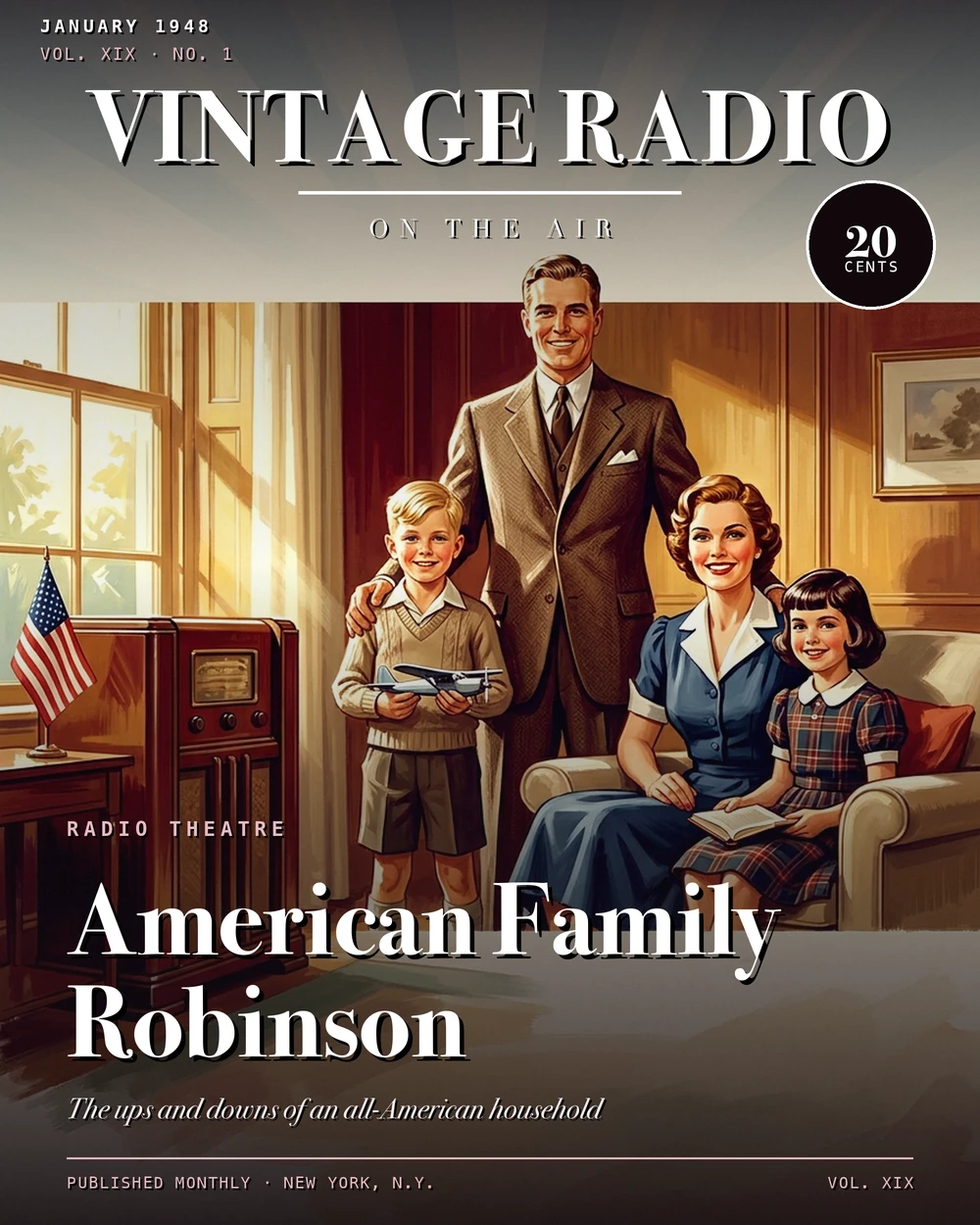
American Family Robinson
What It Actually Was
American Family Robinson looked, on the surface, like any other slice-of-life radio soap from the 1930s. It ran fifteen minutes, followed a family through everyday domestic friction, and aired on local stations across the country. What set it apart from nearly every other show on the dial was who made it and why. The program was produced by the National Industrial Council, a front group for the National Association of Manufacturers, and its entire purpose was to carry free-enterprise, anti-New Deal politics into ordinary American homes without sounding like a political broadcast. The Robinson family name was chosen to evoke quintessential American ordinariness — no connection to any novel or castaway story, just plain, recognizable people whose problems and opinions could stand in for any family in any town.
The show was the brainchild of Harry A. Bullis, vice president of General Mills and chairman of NAM's public relations committee. Bullis understood that a direct advocacy campaign would reach only audiences already sympathetic to industry's position. A drama about a likable family, on the other hand, could slip past defenses. American Family Robinson was, by NAM's own accounting, the single most expensive item in its public relations budget during the show's run — which says a great deal about how seriously the organization took it.
How It Got on the Air
Getting a program like this onto American radio in the 1930s required some maneuvering. Major networks, NBC in particular, were wary of carrying content that could be seen as violating the FCC's public interest mandate, and the show's overtly anti-New Deal stance made it a liability for any network that had to answer to federal regulators. The solution was syndication. Starting in the fall of 1934, the National Industrial Council had each episode cut onto 16-inch transcription discs and distributed through the World Broadcasting System to independent stations around the country. Local sponsors paid for airtime, which meant NAM's name didn't have to appear prominently in the transaction.
By the late 1930s, nearly 300 independent stations were broadcasting the program. That reach made it one of the most widely distributed syndicated radio serials of the decade, even though it never appeared on a major network. The National Association of Broadcasters, aware of what the show was, issued a memo encouraging stations to tell their audiences that American Family Robinson was sponsored content and did not necessarily reflect station management's views. The program was controversial enough to prompt that warning, but popular enough that stations kept airing it anyway.
The Town, the Family, and the Format
The show was set in the fictional small town of Centerville, where Luke Robinson was the editor of the Centerville Herald — a paper whose motto was "Covers Centerville Like the Dew." Luke's family in the first series included his wife Myra, their children Betty and Bob, and Betty's husband Dick Collins. The show's ideological work was done largely through a recurring foil: William "Windy Bill" Winkle, a humorous socialist with a fondness for get-rich-quick schemes. Luke's debates with Windy Bill gave the writers a natural format for contrasting free-enterprise values against what NAM considered dangerous economic thinking, and it let them do it through comedy rather than lecture.
The series was written by Douglas Silver and Marjorie Bartlett Silver and directed by Martha Atwell. Chester Stratton played Luke Robinson through the first series, from 1934 into the late 1930s; when production continued into 1940, Bill Adams took over the role. The 1940 version shifted the setup: Luke was no longer a newspaper editor but had taken on management of his Aunt Agatha's store, and Myra had become a radio personality hosting a marriage advice program. The surviving 1940 episode titles track Luke and Myra through a period of marital strain — he walks out, he's homesick, he eats lunch alone, his resolve to be a better husband eventually turns things around. The domestic drama is the foreground; the political framing is structural rather than explicit in those episodes.
The Episode Record
The catalog's 40 episodes carry broadcast dates running from July 21 to November 3, 1940, placing them entirely within the second series. Titles like "Luke Has Walked Out on Myra and is Homesick," "Myra Has Taken Up A Radio Career," and "All the Customers Are Wondering Where Luke is" sketch out a storyline in which Luke's absence from both his marriage and his store becomes the central tension. The small-town commercial setting — the emporium, the loyal customers, the train to and from Birch Falls — gives the 1940 episodes a texture somewhat removed from the overt ideological sparring of the Windy Bill years, though the values embedded in Luke's eventual return to responsibility are consistent with the show's broader project.
Radio collector J. David Goldin's RadioGoldIndex documents 148 episodes spanning 1934, 1940, and 1941, which gives a sense of the show's full scope beyond what any single catalog holds. The Library of Congress lists 38 episodes on tape from April to August 1940. Surviving episodes have been transferred from original 16-inch transcription discs by collector and radio historian Randy Riddle; a portion of those transfers are held at the Rubenstein Rare Book & Manuscript Library at Duke University.
Why It Matters Now
American Family Robinson is studied today less as entertainment than as a case study in how industry-sponsored content operated during the New Deal era. The show was part of a broader NAM campaign that included speeches, leaflets, and films distributed to schools — all aimed at shaping public attitudes toward free enterprise and against the economic policies of the Roosevelt administration. The radio serial was the campaign's most intimate weapon, delivered into living rooms as domestic drama rather than institutional messaging.
The show's political and propaganda dimensions are documented in William L. Bird's Better Living: Advertising, Media and the New Vocabulary of Business Leadership, 1935–1955 (Northwestern University Press, 1999), and in a chapter of The Disinformation Age (Cambridge University Press). These scholarly accounts place American Family Robinson in a tradition of industry-funded media that helped define how corporations learned to speak to mass audiences — not through editorials or advertisements but through characters people could recognize as neighbors.
Listening to the surviving 1940 episodes, what's striking is how functional the soap opera format is as a vehicle. Luke Robinson is a recognizable type — decent, a little proud, struggling to balance work and marriage — and the show's ideology rides along almost invisibly beneath storylines about marital stubbornness and store management. That was exactly the point, and it worked well enough that NAM kept funding it for six years and 300 stations.